In paving, a 1% difference in compaction can mean the difference between meeting specs and collecting bonus pay. Yet many crews still rely on familiar rolling patterns: a single breakdown roller, an intermediate roller and a finish roller moving behind the paver as they always have.
According to Brad Belvin, Sales Manager at Sakai America Inc., the biggest opportunity for improvement may come from rethinking what happens during the breakdown phase.
“Most of your compaction is won or lost in the breakdown phase,” Brad says. Those first passes occur while the mat is still hot enough to respond. Once temperatures begin to drop, crews have far fewer opportunities to reach target density, no matter how many passes follow.
Traditional rolling patterns can make that challenge even harder.
As thinner lifts become more common, faster cooling rates can leave a single breakdown roller struggling to cover enough ground before the compaction window closes.
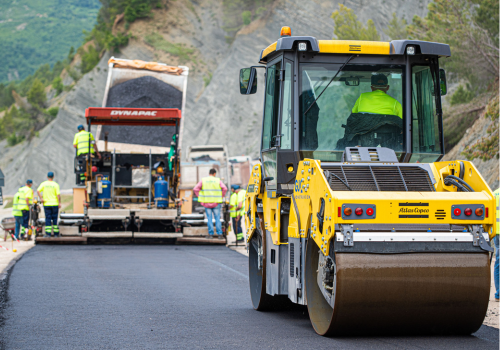
The data backs that up. Federal Highway Administration studies have shown that projects using echelon, or dual-breakdown, rolling routinely achieve higher densities than those relying on a single breakdown roller. According to Brad, nine out of ten projects using echelon rolling exceeded 94% compaction, while half reached 95% or better.
That difference matters. For contractors pursuing density incentives, moving from acceptable results to bonus-level compaction can depend on just a few additional tenths of a percent.
Seeing the Window More Clearly 
Experienced operators bring valuable judgment to the breakdown phase, but even the best rolling pattern is affected by time, temperature, and production pace. Thin lifts cool quickly, narrowing the window in which the mat will still respond to compaction. On some projects, crews may have only a few minutes to achieve target density before the mix becomes less workable.
That is where intelligent compaction can help reinforce what is happening in the field. Rather than replacing operator experience, coverage maps give crews another way to see whether the breakdown train is keeping pace with the paver and whether each section of the mat is receiving consistent attention while the temperature window is still open.
When gaps appear, the issue is not necessarily operator skill. It may be that one breakdown roller simply cannot cover enough ground under the conditions of the job. A second breakdown roller can increase the amount of compaction completed while the mix remains workable, helping crews respond to thinner lifts, faster cooling and higher production demands.
Equipment as a Toolkit
Success is not about finding a single perfect roller. Different projects, mix designs and lift thicknesses demand different approaches.
Oscillation rollers, for example, can help improve smoothness. Pneumatic tire rollers help knead the mix, reducing air voids and increasing density from the bottom up. Vibratory rollers remain highly effective when matched to the right material and operating settings.
The opportunity isn't always tied to buying new equipment. In many cases, the necessary tools are already available. The real advantage comes from understanding when and how to deploy them.
That is why Brad encourages contractors to lean on manufacturers and dealers when trying new compaction strategies. Tender zones, highly modified mixes and unfamiliar roller settings can all affect performance, and some crews abandon otherwise effective techniques before giving them a fair evaluation.
What Gets Improved, Gets Repeated
The biggest gains often come from consistent execution rather than dramatic changes.
A dual-breakdown pattern only works if it is used consistently. New roller settings only deliver results when operators understand why they matter. And intelligent compaction data creates value when crews leverage it in real time.
Field leaders play a critical role. When supervisors reinforce new practices and track results, crews are far more likely to stick with them instead of reverting to familiar routines under schedule pressure.
A 1% improvement may not sound significant. In paving, however, that single percentage point can separate average results from bonus-level performance.
Small changes in rolling patterns, equipment selection and compaction strategy are rarely revolutionary. Yet when applied at the right time and with consistency, they can improve density, smoothness, and profitability—one percentage point at a time.
Subscribe to receive news and insights about everything from mainline to maintenance, and updates about the upcoming World of Asphalt show.